Working remote? Start with Good Morning
At the risk of being the 100th blog post you’ve read this week on remote work techniques.

At the risk of being the 100th blog post you’ve read this week on remote work techniques, I thought I would share a few things that we’ve adopted across our team at Tarmac working with our clients to ensure that we are able to deliver software at speed with quality and transparency.
I’ve said this in previous posts and I don’t think it can be emphasized enough. The best software development teams, regardless of skill level, adopt communication and transparency as a core value and weave that through everything that they do. It is simply a fact that teams that communicate fluidly and transparently outperform teams that do not. This is true for teams in a traditional office setting, fully remote, and everything in between.
It turns out that it isn’t as hard as you’d think. Simple things tending to be the most successful over time, let me share some of our strategies at tarmac.io for building a culture of transparency and communication.
Say good morning
As we sit down to begin the work day every member of the team starts off with a simple “Good Morning”. The simple act of “Good Morning” signals to the rest of the team that I am here, ready for work and beginning my day.
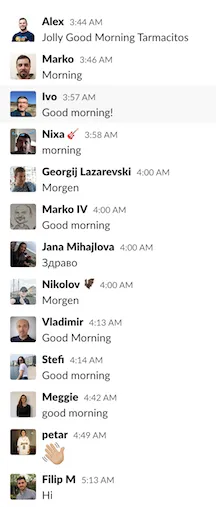
This practice looks and sounds somewhat corny but think about the psychology behind this practice and it will become one of the more significant “little things” the team can do to create an environment conducive for communication.
For our practice it has become the base layer, the foundation, that the rest of our communication builds upon. As an aside there is something comforting in the knowledge that the team is online, present, and engaged for the day.
Use video and stick to a routine
With a team working remotely it is even more important to be diligent about the use of video and adhering to a set meeting schedule.
Use video! It’s important that we see one another and communicate with one another where body language and facial expression can be seen and understood. Next to live and in person video communication has the next highest bandwidth of information and we should use that to our advantage all the time. We require Zoom, Hangout, Teams or the like unless bandwidth issues prevent it.
Standups, now more than ever, are more important. These are now critical meetings that force people to get on the same page for the day and to assist one another. If standups are every day at 9 a.m. place a strong emphasis on being connected, with video, and ready to go at 9 a.m. not 9:01 or 9:04.
Over communicate
Throughout the day we should observe regular flow of communication from the whole team in group channels. For a lot of teams this doesn’t come naturally, we need to find ways to encourage a stream of daily conversation. We like to see lots of chatter, the more the better. This is an indicator that the team is comfortable communicating with one another.
For our clients and within our own teams we look for the following things:
-
pull request review notifications
-
asking for assistance from a teammate
-
discussion around design, bugs, user feedback
-
memes
-
jokes
Any of the above and more are signs of a health communication culture. Group channels with little or no activity should be an immediate red flag to the team. At best it’s happening in isolation (see below) at worst it’s not happening at all. Both are dangerous.
Respond quickly to teammates
Working on a team requires a certain level of social contract with one another. One key item in that contract, we think, is response time. If a question is asked or a pull request is submitted for example, the team should do everything in their power to respond quickly and help that person move on with their day.
If we can remember that it’s all about the team we’ll quickly recognize that the team isn’t able to function to its full potential unless every member is able to move forward. To that end, watch and participate in the channels. If someone is asking you directly or unable to move forward — get in there and help.
Encourage group conversations over 1-on-1 chats
For a lot of people it is more comfortable to communicate 1-on-1 in a chat setting. While this may be more comfortable this communication behavior will be at odds with your overall communication strategy. We’ve found that requiring all communication into the group chat setting keeps everyone apprised of what the team is working on, or struggling with. This invites others to weigh in. In more situations than I can count we’ve found that when a team member struggles or needs help often others do as well. If all communication is 1 on 1 then the whole team has just lost an opportunity to learn and grow together.
Do everything in group chat and rarely use direct messaging, it works amazingly.
End the day with an email
Transparency is so core to what we do at Tarmac that we finish our days off strong with a simple email message that mimics the standup format. The template we use is:
-
What we did today
-
What we plan to do tomorrow
-
What are we blocked on
This simple process that takes us less than 5 minutes to write, clearly communicates our progress. It gives others an opportunity to catch discrepancies in the plan and more importantly invites everyone to help and resolve blockers before the next day begins.
As i’ve often said (here) great teams do little things constantly to communicate well and build great software. I think oftentimes people overcomplicate what this work actually is and get lost in the bits and bytes of technology. Software development is fundamentally an exercise in communication; those companies that recognize that reality and focus on the little things will produce better teams and therefore better products.
Thanks for reading!