From a Whiteboard during Client Week to a Stage at the Databricks Data + AI Summit
Back in January, during our Client Week in Montevideo — an annual in-person event hosted by Tarmac for our clients — an idea was born inside a windowless room we.
Back in January, during our Client Week in Montevideo — an annual in-person event hosted by Tarmac for our clients — an idea was born inside a windowless room we fondly call “the bunker.” Client Week is more than just a series of meetings; it’s a unique opportunity to connect in person with colleagues and clients from around the world, strengthen relationships, and collaborate on the challenges that matter most. There, armed with markers and a whiteboard, we sketched the first version of what would become Red Stapler: a company-wide, human-created file ingestion platform that is now reshaping how Clinician Nexus handles data.
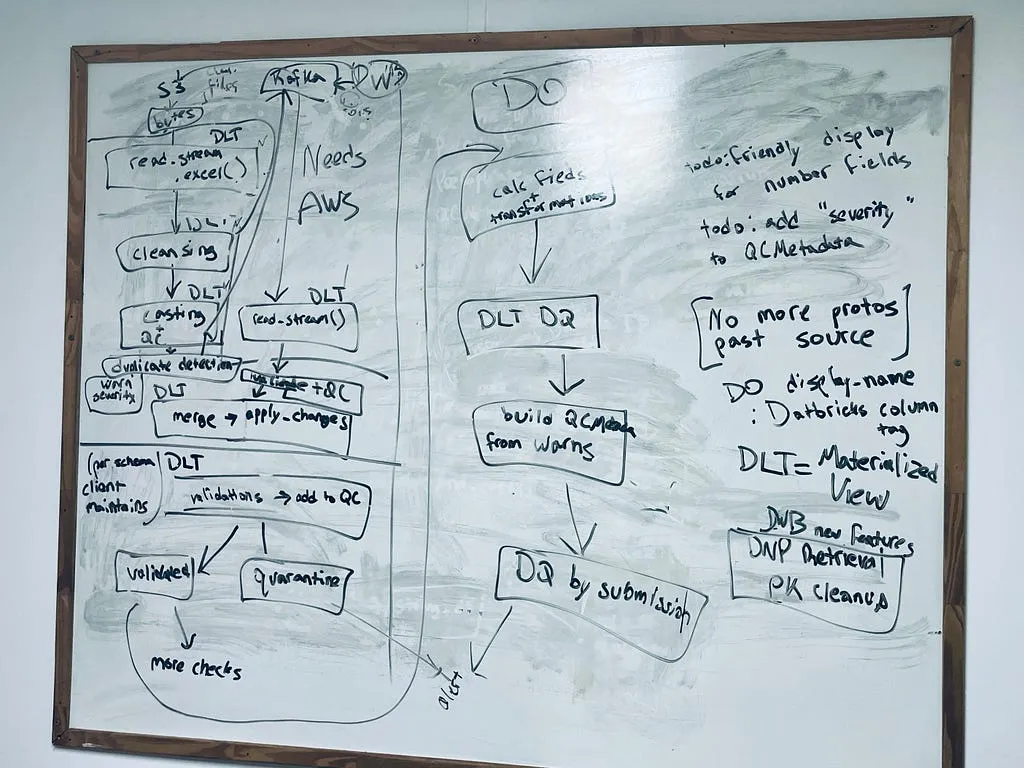
Turning the Whiteboard Sketch into Impact
In just a few months, we turned that idea into a fully working proof of concept (POC) using Delta Live Tables (DLT) and streaming pipelines in Databricks. The mission: validate whether we could build a unified, streaming-native ingestion system for both file inputs and real-time user edits — with strong governance, auditability, and adaptability.
Red Stapler is a streaming-native system that:
-
Combines file ingestion and real-time user edits in a single DLT pipeline.
-
Uses Protobuf and Buf Schema Registry (BSR) to enforce schemas and data-quality rules with backward compatibility.
-
Stores all records — valid or invalid — in a Type 2 Slowly Changing Dimension (SCD) table, enabling full history and real-time quarantine views.
-
Runs on DLT Serverless and Bufstream (Kafka-compatible), scaling down to zero when idle.
-
Ensures consistent validation, fast updates, and complete audit trails.
One of the biggest challenges? We were often ahead of Databricks’ feature releases, working with cutting-edge capabilities — sometimes still in preview — and pushing the platform to its limits to achieve speed, reliability, and low cost.
A Stage at the Databricks Data + AI Summit
The success of Red Stapler didn’t go unnoticed. It earned a spot at the Databricks Data + AI Summit 2025 in San Francisco, California, where Dwight Whitlock, Clinician Nexus’s lead Data Architect, delivered the session: 🗣️ “Unifying Human-Curated Data Ingestion and Real-Time Updates with Databricks DLT, Protobuf and BSR.”
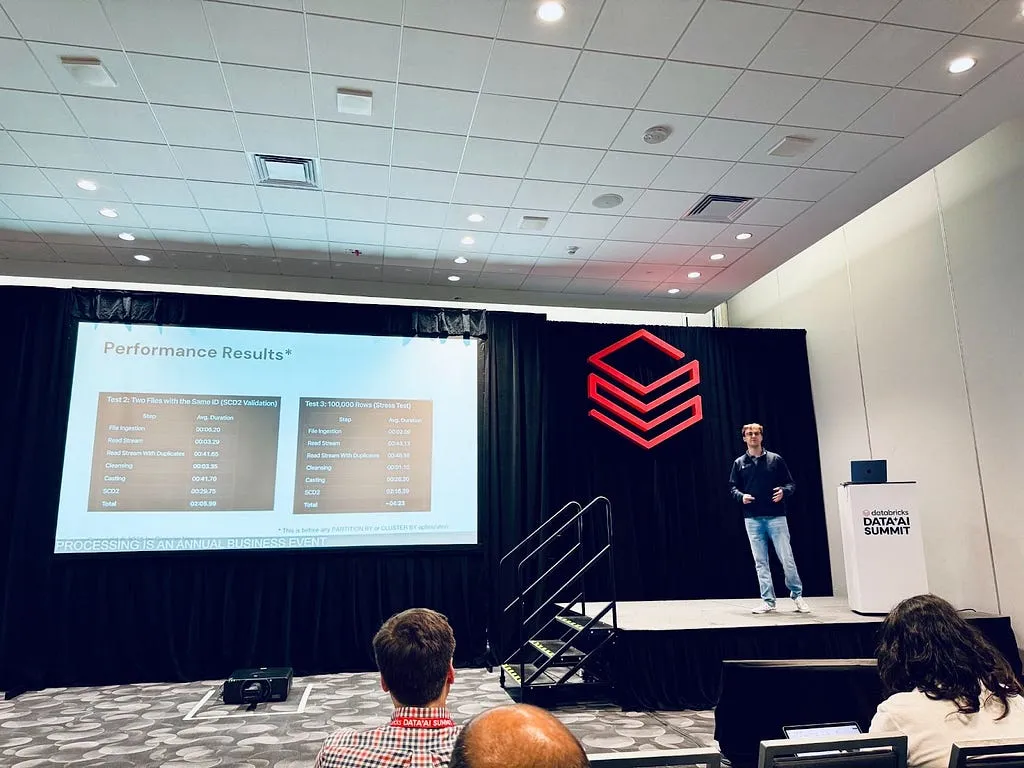
The session sparked a lot of interest from other data teams dealing with the same tough problems — whether in healthcare, finance, or large enterprise systems. It was proof that the real win isn’t just in the tools, but in how you bring people together to solve tough problems.

More Than Just a Project
At Tarmac, we believe in being more than a vendor, we help teams scale fast, adapt to any tech stack, and deliver real impact — not just code. Whether it’s augmenting teams, accelerating delivery, or bridging skills gaps, we aim to be a true extension of your product team. It’s the essence of what we offer through our exceptional nearshore software consulting.
We’ve been partnering with Clinician Nexus for several years now, and the relationship we’ve built is one of trust, collaboration, and mutual respect. We don’t just provide support — we become part of the team.
Challenging projects like Red Stapler thrive on strong, cross-functional collaboration. From DevOps and Data Engineers to Data Architects and DataOps, we brought together a multidisciplinary team to meet ambitious goals — and the outcome speaks for itself.
Three highlights we’re proud to share from the Tarmac side:
-
Speed to execution: From whiteboard sketch to working POC in just months.
-
Client Week impact: In-person co-design leads to real innovation and momentum.
-
Shared success: Having our clients present their achievements at the Databricks Summit was a proud milestone.
Red Stapler is more than a successful project — it’s what happens when bold ideas meet agile and collaborative teams.

Thanks for reading!